Teltonika Codec8 vs Codec8 Extended - What's the Difference and When Does It Matter
Codec8 and Codec8 Extended share the same outer structure but differ in IO element layout. Know the difference before your parser silently breaks.
Both codecs encode Teltonika AVL data with the same outer packet structure. The difference lives inside the IO element - and if your parser doesn't handle both, you'll see silent failures or corrupted data when a device sends the wrong variant.
The Key Difference
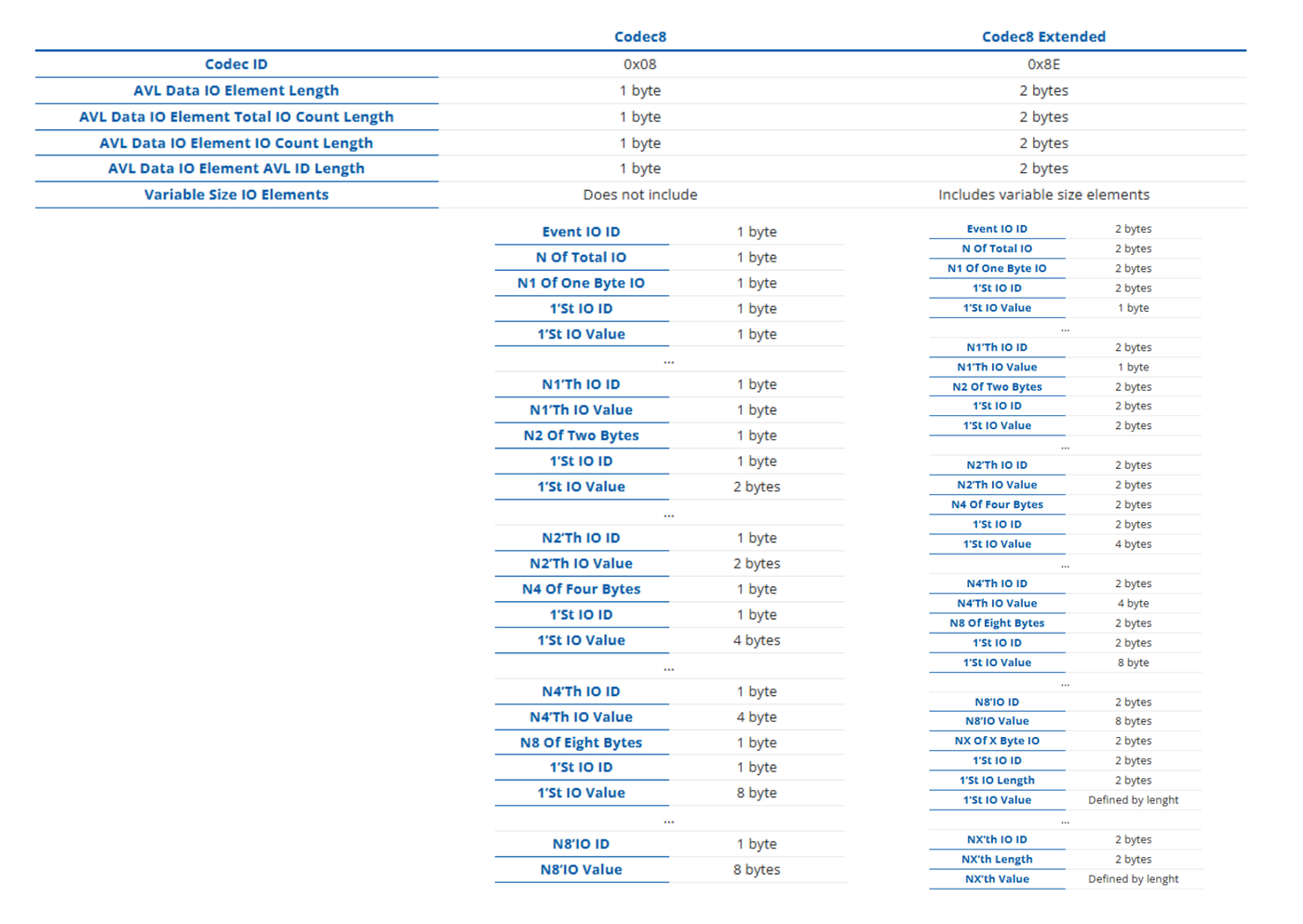
Codec8 supports IO parameter values up to 8 bytes. IO parameter IDs are 1 byte (range: 1–255).
Codec8 Extended adds Variable-size IO elements (defined by length) and extends IO parameter IDs to 2 bytes (range: 1–65535).
Codec8:
- Max IO value size: 8 bytes
- IO parameter ID width: 1 byte
- Codec ID byte:
0x08
Codec8 Extended:
- Max IO value size: X bytes (defined by length)
- IO parameter ID width: 2 bytes
- Codec ID byte:
0x8E
When Does Each Appear?
Codec8 handles basic tracking: position, speed, ignition, standard IO. Devices switch to Codec8 Extended when configured with IO parameters above ID 255, or values requiring more than 8 bytes - like CAN bus readings, J1939 data, or certain fuel system values. Many modern Teltonika configurations default to Extended even for simple setups, because of the broader ID range.
Parser Implications
Read the codec ID byte first (0x08 vs 0x8E) and branch accordingly.
The most common mistake: a parser written only for Codec8 will misread byte offsets when Extended packets arrive, silently producing wrong data.
Testing Both Without Hardware
Telemify sends real Codec8 and Codec8 Extended packets to your server. Configure virtual devices with high-ID or large-value parameters to force Extended mode, and validate your parser handles both formats - entirely in software, before any hardware arrives.
Try Telemify for free 👉 https://telemify.io