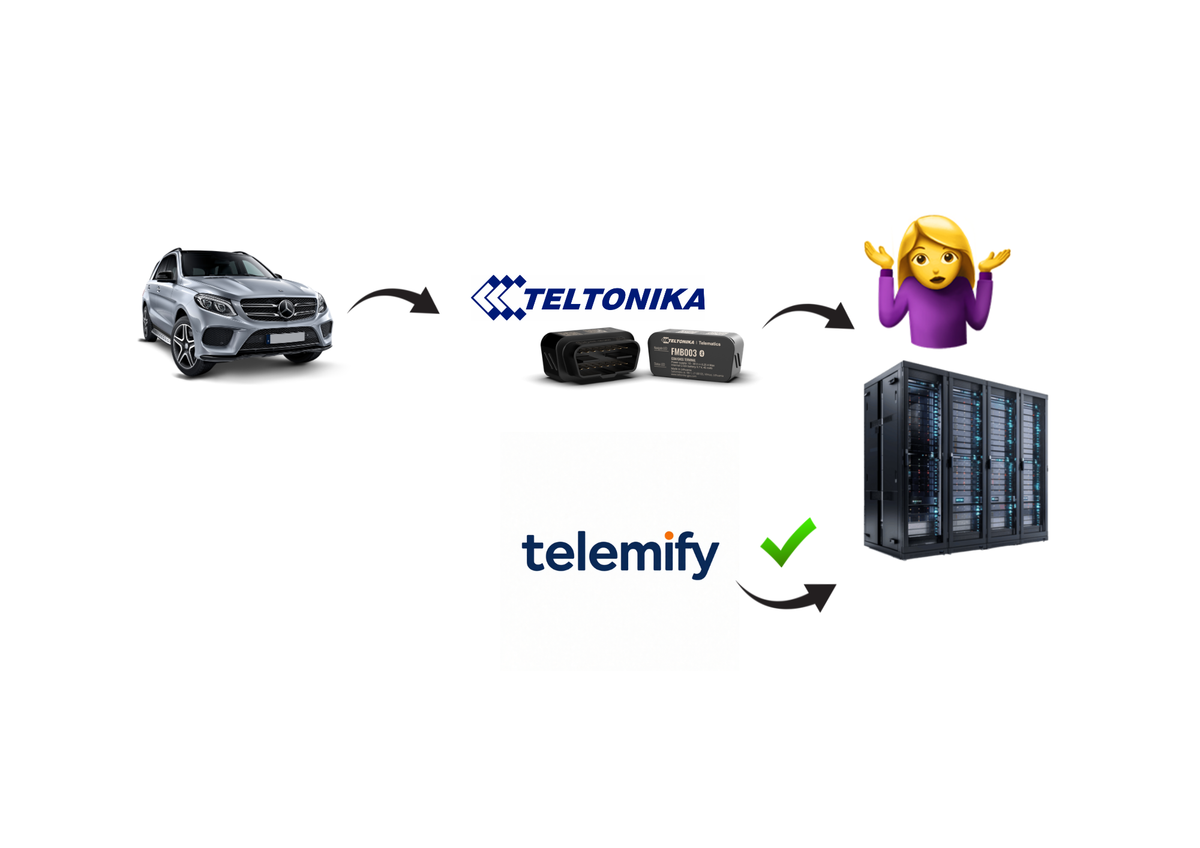
Testing Teltonika Codec8 AVL Data Without a Real Device
Test your Teltonika Codec8 AVL parser without a physical device. Validate handshake behaviour, IO parameters, and edge cases entirely in software.
Testing your backend's Codec8 handling normally requires a physical device, SIM card, and active mobile connection. Here's a more practical approach.
What You're Actually Testing
"Testing Codec8 and Codec8 Extended" covers several distinct things:
- Parser correctness - does your code correctly decode the binary structure?
- IO parameter handling - does your backend interpret specific AVL IDs correctly?
- IMEI handshake - does your server accept connections and send the right response?
- ACK behaviour - does your server send the correct acknowledgement and handle retransmissions?
- End-to-end flow - does decoded data reach your database or map view correctly?
Static fixtures cover unit tests. They don't tell you whether your live TCP server behaves correctly under real traffic.
The Traditional Approaches and Their Limits
- Physical device on a bench - works, but requires hardware, mobile data, and manual setup every time.
- Replaying packet dumps - useful for regression tests, but can't simulate continuous movement or dynamic data.
- Handcrafted binary payloads are tedious, error-prone, and don’t cover the full IMEI + continuous data flow your server will see in production.
Device Emulation
Telemify handles the complete device-to-server flow: IMEI handshake, Codec8 and Codec8 Extended packet encoding, and retransmission on missing ACKs - all from a virtual device your server can't distinguish from a real one.
Configure a specific IMEI, set your server's host and port, and start the emulator. Then use it to test:
- IO parameter parsing - include IO ID 239 (ignition) and verify your backend identifies it correctly.
- Edge cases - send records with zero GPS coordinates (device lost satellite fix) or IO values at min/max boundaries.
- Codec8 Extended - configure high-ID parameters to force Extended packets and confirm your parser handles both codec variants.
- DTC Fault Codes - simulate real vehicle fault codes and verify your platform handles them correctly - from detection to alerts.
- Eventual Records - trigger event-driven records like towing, crash detection, and harsh driving on your own timeline to verify how your backend reacts to real-world events.
Once configured, run the same scenario as many times as you need - consistently, without hardware or driving.
Try Telemify for free 👉 https://telemify.io